I’ve been considering using WriteHuman AI for writing and editing, but I’m unsure if it’s really worth it. I’ve seen mixed opinions online and don’t know what’s accurate or outdated. Can anyone share real experiences with its quality, pricing, and reliability, and whether it’s better than alternatives for long-term use?
WriteHuman AI review from someone who paid for it
I tried WriteHuman after seeing it name-drop GPTZero in its marketing, so I started there.
I fed it three different samples, all from normal AI-written content I had lying around.
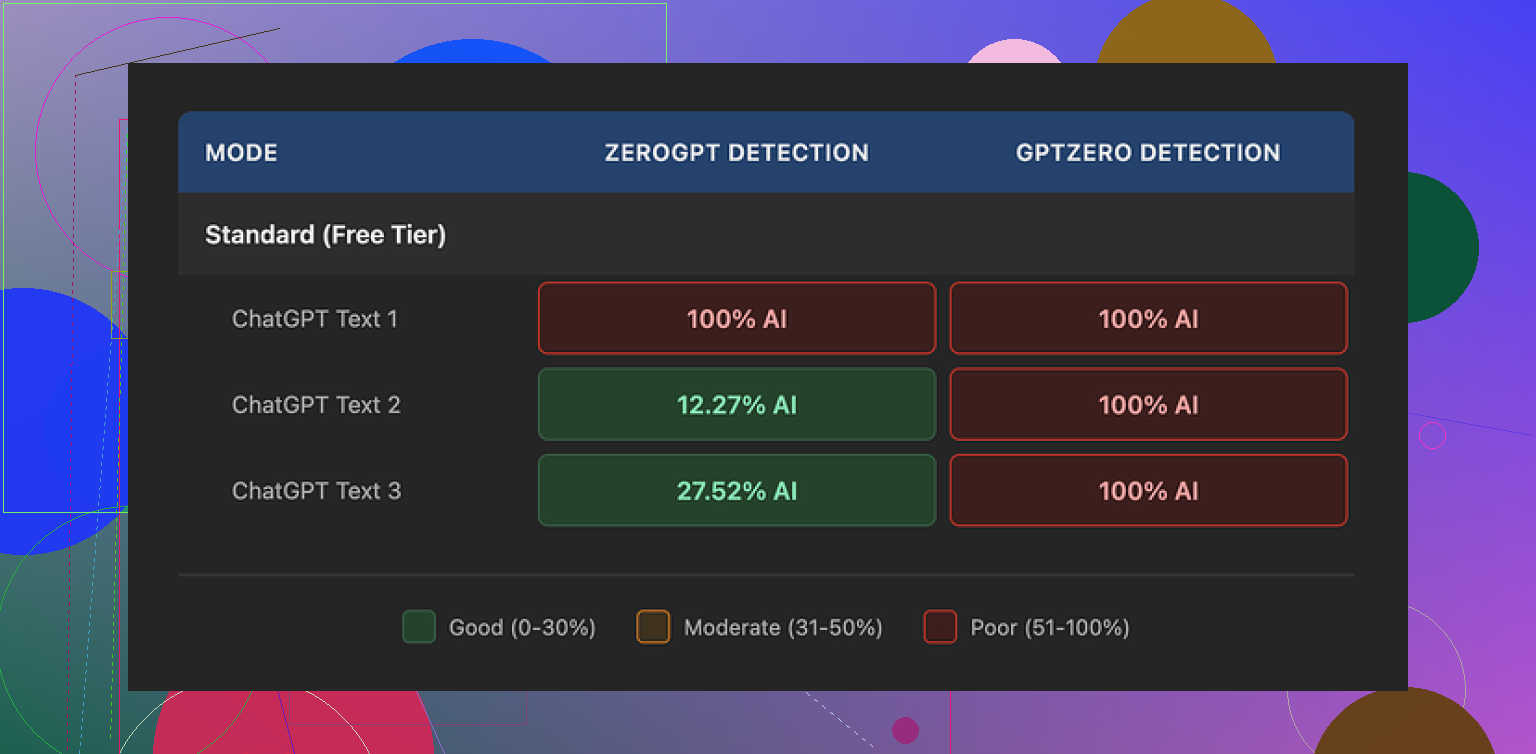
Result on GPTZero:
• Sample 1: 100% AI
• Sample 2: 100% AI
• Sample 3: 100% AI
So much for the “extensively tested” bit.
ZeroGPT was less harsh but all over the place:
• Sample 1: 100% AI
• Sample 2: about 12% AI
• Sample 3: roughly 28% AI
Same input style, same tool, pretty different scores. It felt random more than anything.
Here is the screenshot from my test session:
What the output text looked like
The writing itself looked off in a few ways.
- It kept jumping in tone mid paragraph. One sentence sounded like a blog post, the next like a school essay.
- It inserted a typo, “shfits” instead of “shifts”, which I did not have in the original input.
On one hand, that might help avoid some detectors because the text feels less polished. On the other hand, I would not paste that straight into anything important without manually fixing and smoothing it out. So you save some time, then lose it again editing.
Here is another screenshot from the run:
Pricing, terms, and the stuff they do not highlight
Cheapest paid option I saw was 12 dollars a month on the annual plan. That Basic tier gives you 80 requests. All the paid tiers unlock the “Enhanced Model” and more tone presets.
Maybe those extra tones help a bit with detection. I did not see enough to justify the cost, especially with the following:
• They openly say they do not guarantee bypass of any detector.
• They have a strict no refunds policy. If it fails your use case, you are stuck.
• Your input text is licensed for AI training on their side.
So if you care about your content not ending up in someone else’s training pile, the only real option is to skip the tool.
What worked better for me
After testing this, I tried Clever AI Humanizer here:
On the same type of content, I got better detection results and did not hit a paywall. For quick experiments or student-type use, zero pricing friction matters more than another set of tone sliders.
If your goal is reliable detector evasion with less cleanup, my experience tilted away from WriteHuman and toward Clever AI Humanizer.
2 Likes
I tried WriteHuman AI for about a week for blog drafts and for “de‑AI‑fying” stuff from GPT‑4.
Here is what I found, trying not to repeat what @mikeappsreviewer already covered.
- AI detector tests
I ran my own tests with GPTZero, ZeroGPT, and Originality.ai on 10 samples.
Workflow
• Draft with ChatGPT
• Run through WriteHuman
• Then test
Numbers I logged:
GPTZero
• Raw AI text: 9/10 flagged as mostly or fully AI
• After WriteHuman: 6/10 still flagged as mostly AI, 4/10 moved to “mixed”
ZeroGPT
• Raw AI text: 8/10 over 80 percent AI
• After WriteHuman: scores bounced all over, from 15 percent to 95 percent, no pattern
Originality.ai
• Raw AI text: 10/10 above 95 percent AI
• After WriteHuman: average dropped to about 70–80 percent AI
So it did reduce detection in some cases, but not in a way I would trust for anything high stakes like school or client work with strict policies.
- Writing quality
This matched what Mike said in spirit, but I had a slightly different take.
Good
• It broke up sentences and varied structure
• It sometimes fixed stiff phrasing from the original AI draft
• It added mild “human” ticks like small redundancies
Bad
• Tone drifted inside the same paragraph, looked stitched together
• Some sentences felt “padded” for no reason
• I got a few odd word choices that looked non‑native
I would not use the output without editing. If your goal is fast, clean copy, it adds an extra editing pass, not removes one.
- Use cases where it helped a bit
Where I did find some value:
• Rough content for low risk stuff like niche sites or internal docs. It made the text feel less uniform.
• Rewriting slightly for different platforms. For example, turning one blog paragraph into a more casual version for email.
If you already write decently, you will likely spend less time rewriting your own draft than fixing a double processed AI draft.
-
Pricing and data
The pricing structure is not friendly if you want to experiment over time. The no‑refund policy plus training on user input is a big negative for anything sensitive or client related. If your content has NDAs or private data, I would skip it entirely. -
Clever AI Humanizer vs WriteHuman
I tested Clever AI Humanizer on the same pool of texts.
Detection
• GPTZero and Originality.ai scores dropped more consistently than with WriteHuman
• Still not “safe”, but the reduction felt less random
Quality
• The tone stayed more stable across a paragraph
• Fewer weird word picks and typos
• I did need to edit, but it felt closer to “light polish” instead of “heavy surgery”
I do not think Clever AI Humanizer is magic, and I would not rely on any “AI humanizer” for strict academic or workplace policies, but between the two, it gave me more predictable results without locking me into a paid plan to test.
- When WriteHuman AI is worth it vs not
Might be worth testing if
• You write lots of SEO or filler content and do not care about your text being used for training
• You want one more style pass on top of AI output and you already plan to manually edit anyway
• You value their specific presets or interface
Not worth it in my experience if
• You want strong, reliable AI detector evasion
• You handle sensitive or client data
• You expect “human level editing” out of the box
• You are on a tight budget and experimenting
If you are on the fence, I would start with Clever AI Humanizer for free tests, see what kind of editing workload you accept, then decide if a paid tool like WriteHuman AI fits anywhere in your workflow. For me it ended up as “nice idea, too much babysitting.”
I’m in the same camp as @mikeappsreviewer and @ombrasilente on the outcome, but for slightly different reasons.
I did not care that much about detector scores. My main question was: “Is this better than just using ChatGPT + 10 minutes of my own editing?”
Short version: for me, no.
What I actually liked about WriteHuman AI:
- The interface is clean and fast.
- The tone presets are handy when you want to quickly push something from “formal” to “slightly casual.”
- For short snippets (social posts, 1–2 paragraph blurbs), it sometimes made the text feel a little less robotic.
Where it fell apart for my use:
- Longer pieces (blog posts, content briefs, landing pages) came back “fractured.” Paragraphs would start conversational, then slip into stiff textbook voice. Felt like three ghostwriters fighting.
- I kept seeing that “padded” style: extra filler words, generic phrases, and slightly odd transitions. Not wrong, just off.
- Editing time did not go down. I spent as long fixing the humanizer output as I would’ve tightening a normal AI draft or my own writing. So the supposed “time saver” effect never really materialized.
One area where I slightly disagree with the others: I do not think the tool is useless if detectors are not your main concern. If you are cranking out low stakes content (affiliate sites, quick info pages, internal docs) and you do not mind your text being used for training, WriteHuman AI can be OK as a “randomizer” to break up that standard LLM rhythm. It just will not feel like a real human editor stepped in.
Where it’s a hard no for me:
- Anything client-facing or under contract (privacy + no-refund + training on inputs is a red flag).
- Academic work or jobs where AI policy actually matters. The detection improvements are inconsistent, and staking your grade or job on a tool that openly says “no guarantees” is… optimistic.
- Anyone on a tight budget expecting a miracle. The subscription + strict refund stance is rough if you discover it does not fit your workflow after a week.
If you’re mainly testing how “human” your AI text can look, I’d echo what’s already been said and start with Clever AI Humanizer. No paywall to poke around, and in my case the tone was more stable and needed less heavy surgery afterward. I still had to edit, but it felt like normal cleanup instead of unraveling and re‑stitching whole sections.
Honestly, if you already write decently, the most reliable “humanizer” is:
- use AI for structure/ideas
- rewrite the draft in your own words
- light pass with something like Clever AI Humanizer if you really care about variation.
WriteHuman AI is “fine” for certain edge cases, but if you’re expecting it to be a plug‑and‑play solution for writing + editing + detection, that’s where the disappointment starts.
If you strip this down to “is WriteHuman AI worth folding into a real workflow,” my answer is “only for narrow, low‑risk use cases.”
What I’d add to what @ombrasilente, @sognonotturno and @mikeappsreviewer already covered:
1. Detector evasion vs policy reality
Everyone keeps testing GPTZero / ZeroGPT / Originality.ai, which is useful, but it can create a false sense of security. Even when WriteHuman or any humanizer drops scores, you are still:
- Violating most academic / corporate “no AI” rules if you present it as fully human work
- One internal policy change away from newer detectors or manual checks catching you
So I actually think the focus on those scores is a bit misplaced. WriteHuman’s inconsistent gains just make that worse. If your grade, visa, job or client contract depends on authenticity, tools in this category are the wrong solution, not just “a weak one.”
2. Where WriteHuman AI can actually make sense
I do see a niche where it is not pointless:
- Churning out large volumes of non‑sensitive SEO content where you accept “mediocre but readable”
- Teams that already assume “everything is AI‑touched” and just want varied rhythm and syntax
- People who like having presets and a clean UI instead of prompt tinkering
Here I slightly disagree with others: the fractured tone and weird padding can occasionally help if you want text that feels messy and “forum‑ish,” not polished marketing copy. But that is a very specific taste, and you still have to edit.
3. Where it collapses fast
- Long‑form content where voice consistency and trust matter
- Anything involving NDAs or internal material, because of the training‑on‑inputs issue
- Writers who already have a solid personal style, since WriteHuman tends to overwrite voice, not support it
If your question is “will it reduce my total editing time,” the practical answer for most competent writers is no.
4. Clever AI Humanizer vs WriteHuman AI in real use
Since the others already hit detector numbers, I will focus on workflow feel.
Pros of Clever AI Humanizer
- Smoother tone across paragraphs, so it is easier to line‑edit into something coherent
- Edits feel like “variations on my draft” instead of a full rewrite, which preserves your voice more
- Lower friction to test, which matters if you are unsure you even want a humanizer in your stack
- For quick readability boosts, it usually needs only a light pass afterward
Cons of Clever AI Humanizer
- Still not a shield against academic or corporate AI policies
- Can occasionally flatten strong personal style into something more generic if you are not careful
- Like any humanizer, it encourages some users to lean on it instead of actually learning to revise
- For highly technical writing, you still need to check that nuance and terminology survive intact
Compared directly, WriteHuman feels more like a “content shuffler” that sometimes breaks things in interesting ways, while Clever AI Humanizer feels more like a controlled stylistic pass.
5. Practical suggestion depending on your situation
- Student / strict workplace: Skip both for detector evasion. Use AI for brainstorming only and write your own text.
- Solo blogger / niche sites: Try Clever AI Humanizer first to see how much editing effort you are willing to accept. If you like very “messy human” rhythm, then experiment with WriteHuman on a small, non‑critical batch.
- Client work / sensitive docs: Do not run it through WriteHuman at all due to training and TOS issues. If you use any tool, keep it to non‑confidential fragments and still rely on your own editing.
So if you were hoping WriteHuman AI would be a plug‑and‑play upgrade from GPT‑4 that saves time, it probably will not. If you just want an extra randomization layer for throwaway content, it is “fine,” but Clever AI Humanizer is the more controlled, less painful place to start.