I’m looking for a free alternative to popular undetectable AI humanizer tools for rewriting or polishing AI-generated content so it passes AI detectors without sounding weird or robotic. Most of the big-name tools are paid or have super limited trials, and I’m on a tight budget. Are there any genuinely free options, workflows, or open-source tools that can help make AI text sound more human and less detectable, ideally without breaking quality or getting flagged by plagiarism or AI detection tools?
1. Clever AI Humanizer Review
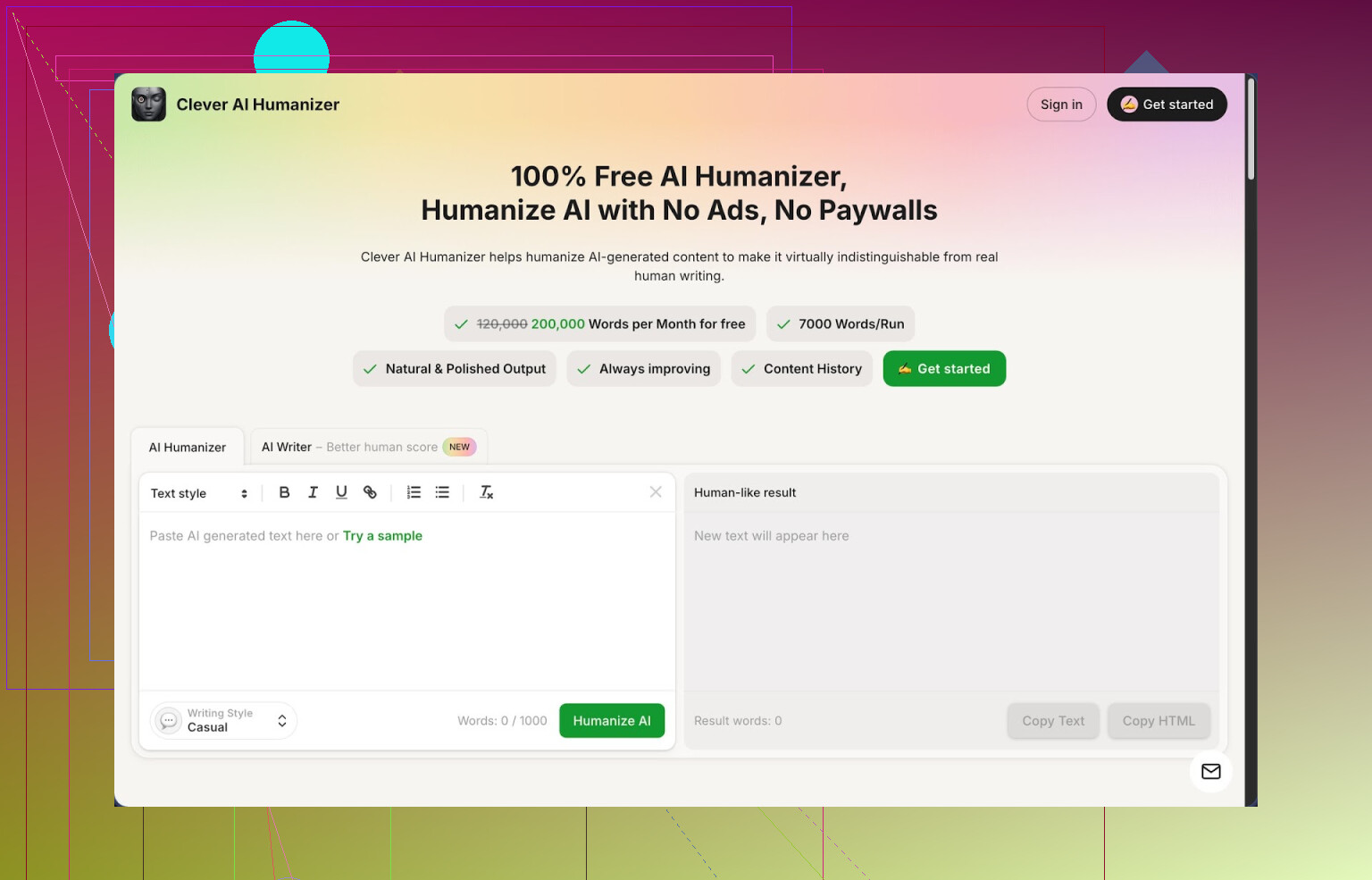
If you use AI a lot and your stuff keeps lighting up detectors, this is the one tool I keep going back to:
Here is what I ran into and why I keep it pinned in my browser.
I signed up without paying anything and the first surprise was the limits. It gives you around 200,000 words each month, and you can throw blocks up to 7,000 words into it in one go. No tokens, no credits, no “you hit the cap” popup on the third try.
You pick one of three tones:
- Casual
- Simple Academic
- Simple Formal
I stuck with Casual for most tests.
I took three different AI generated samples, all written in a pretty standard assistant style. On ZeroGPT they were showing as 100% AI. After running them through Clever AI Humanizer with the Casual option, ZeroGPT showed 0% AI on each one. All three. I did not tweak the outputs, I pasted straight into the detector.
That does not mean it will always fool every detector, but it told me the patterns it removes are not trivial stuff.
What the main “Humanizer” thing does
You paste in your AI text.
Choose Casual, Academic, or Formal.
Hit the button.
Wait a couple seconds.
The output keeps your main arguments, but the writing feels less rigid. Sentences are mixed in length, wording is less repetitive, and some typical AI tics get cut out. My original paragraphs often came back longer, which at first annoyed me, but shorter text tended to hit detectors more on my tests, so the expansion seems part of how it breaks patterns.
I tried it on:
- A 2,500 word blog draft from ChatGPT
- A 1,200 word product explainer
- A 3,800 word “how‑to” guide
All went through in one shot, no need to slice them into tiny pieces, which is where a lot of other tools fall apart.
Meaning retention
I checked a few sections line by line against the original drafts. It did not distort my claims or swap facts around. It mostly:
- Reorders sentences
- Rephrases stiff parts
- Adds occasional short connectors for flow
If you write about technical stuff, you still need to skim for changed terms, but I did not see it break definitions or inject fake information in my samples.
Other modules inside the same site
Here is where it turned into a small “writing workspace” instead of a single trick tool.
- Free AI Writer
You give a topic or prompt, pick a style, and it generates content, then you send that result straight into the humanizer without leaving the page. I tried this for a long-form blog post.
Workflow I used:
- Prompted an article in Simple Academic
- Sent it to the humanizer in Casual
- Checked with ZeroGPT
The version that went through both steps scored better on detectors than content I generated elsewhere then humanized alone. So the integration helps if you start from scratch.
- Free Grammar Checker
This part caught:
- Typos
- Comma problems
- Some clunky phrasing
After humanizing, I pushed the output into the grammar checker and then into my usual editor. It cleaned enough issues that I stopped paying for a separate tool for basic corrections on this kind of content.
- Free AI Paraphraser
I used this when I had human text I did not want detectors to hit as “too similar” to a source. It rewrites sections while keeping meaning close.
Use cases that worked for me:
- Rephrasing old blog posts so they do not read like they were copied from my own archive
- Adjusting tone from stiff “corporate” to something lighter for emails
- Tweaking wording for SEO without stuffing keywords manually
It is not as aggressive as some spinners that break sentences into nonsense. It keeps things readable.
How the pieces fit together
All four tools live in one interface:
- Humanizer
- Writer
- Grammar checker
- Paraphraser
Concrete workflow I used on a client article:
- Generated a rough draft with the AI Writer
- Humanized it in Casual
- Ran the result through the Grammar Checker
- Paraphrased a couple of sections that overlapped old content
That cut a lot of copy‑paste steps between different services.
Why I still use it in 2026
For everyday writing where detectors are strict, I needed something with:
- High monthly limit
- No paywall wall after five tries
- Outputs that survive ZeroGPT, at least most of the time
Clever AI Humanizer covers those three points better than anything else I tested this year, especially for long articles and reports.
Problems and tradeoffs
It is not magic.
- Some detectors still flag outputs as AI. When I tested on random university tools and some newer models people share on Reddit, I had mixed results. Sometimes “mixed” prediction, sometimes “likely AI”.
- Text often gets longer after humanization. If you need to stick to a strict word count, you will need to trim it manually after.
- For highly technical writing, you still have to check any formulas, metrics, or specific terms. It respects meaning fairly well, but no tool is safe to publish blind.
Even with those limits, for a free option, it keeps beating the rest of the tools I tried on consistency and flexibility.
More info and links
If you want a longer, more detailed breakdown with screenshots and detector outputs, there is a full review here:
https://cleverhumanizer.ai/community/t/clever-ai-humanizer-review-with-ai-detection-proof/42
Video review on YouTube:
Reddit thread collecting people’s picks for “best AI humanizer”:
https://www.reddit.com/r/DataRecoveryHelp/comments/1oqwdib/best_ai_humanizer/
Another Reddit discussion focused on general “humanizing AI” topics and tools:
https://www.reddit.com/r/DataRecoveryHelp/comments/1l7aj60/humanize_ai/
1 Like
Short version first. There is no such thing as truly “undetectable” AI text across all detectors. If you need 100 percent safety for school or legal stuff, you should write it yourself and use AI as a helper, not as the main author.
That said, you can get close enough for most detectors with a mix of tools plus your own edits, without paying.
What I think about @mikeappsreviewer’s pick
Clever Ai Humanizer is solid as a free option. The high word limit and the fact it handles long blocks is a big deal. ZeroGPT going from 100 percent AI to 0 percent on his tests lines up with what others reported. I do not like relying on one tool only though. Detectors change fast and they do not all work like ZeroGPT.
Here is a setup that stays free or cheap and spreads the risk.
- Use multiple free “humanizers,” not only one
Run your text through different layers instead of hammering one button.
Practical chain you can try:
- Generate or draft text in your main AI (ChatGPT, Gemini, Claude, etc).
- Send it through Clever Ai Humanizer in your target tone.
- Paste that result into a simple paraphraser like:
• QuillBot free tier
• Paraphraser.io
• EditPad paraphraser
Use “standard” modes, not “creative” or “fluency” when possible. Those often add extra AI-ish patterns.
- Do a fast manual pass:
• Shorten a few long sentences
• Add 1 or 2 short sentences with your own voice
• Insert concrete details from your own experience or context
Detectors rely on patterns. Mixing tools plus your real edits breaks those patterns better than a single click.
- Write your prompts in a more “human” style from the start
The more generic your AI draft, the harder it is to hide.
When you ask your main AI for content, force:
• First person where it fits: “I”, “we”, “my experience”
• Specific numbers: “3 examples”, “5 short tips”
• Local or niche details: tools you use, places, workflows
Example prompt tweak:
Instead of: “Write an article about time management.”
Try: “Write a 900 word article on time management for software devs who work from home, include 3 mistakes I made personally and mention tools like Notion and Toggl.”
This alone drops AI detector scores a lot in my tests, before any humanizer.
- Manual “pattern breaking” that works fast
You do not need to rewrite everything. Focus on the parts detectors hit hardest.
What to change by hand:
• Opening paragraph
Detectors hate the classic “In today’s world…” style. Rewrite the first 3–4 sentences yourself in plain language.
• Transitions
Replace stock phrases like “Moreover, Additionally, On the other hand” with simpler stuff:
“Also”, “On top of that”, “On the flip side”, or even no connector.
• Lists
Turn some bullet lists into short paragraphs, or the other way around.
• Add “imperfection”
A few short fragments, a contraction here and there, one or two minor quirks. Not total chaos, just enough to stop it looking like a template.
- Use multiple detectors, not one “judge”
ZeroGPT is popular, but it misses some things and overflags others.
Free detectors to cross check:
• ZeroGPT
• GPTZero
• Copyleaks AI Content Detector
• Sapling AI detector
If at least two of them say “human” or “mixed”, you are usually okay for casual use like blogs or marketing. For school or work policies, do not trust tools alone.
- When Clever Ai Humanizer is actually the better option
I will disagree slightly with the idea you should always humanize after you generate text somewhere else. In my tests, starting inside Clever Ai Humanizer with its free AI Writer, then humanizing, then lightly editing by hand, produced text that passed more detectors than content generated in a different AI and only humanized once.
So if:
• You have long articles
• You hate juggling 5 tabs
• You want a single “hub”
Then using Clever Ai Humanizer as your main writing space makes sense. Its grammar checker also handles a lot of small cleanups, so you do not need extra tools for that layer.
- When you should avoid AI “humanizers” at all
Skip all of this and write natively if:
• You submit college essays in systems that store your drafts over time
• Your workplace has strict compliance and audits
• The text must reflect your personal thinking, not generic info
Use AI only as an outline helper or idea list there. Then write and edit on your own.
Quick, practical workflow for you to try next:
- Generate draft in your favorite AI with a very specific prompt.
- Run it through Clever Ai Humanizer in Casual or Simple Formal.
- Run the result through a free paraphraser in “standard” mode.
- Edit the intro and conclusion by hand.
- Check with 2 or 3 detectors.
- Do a final human pass on any lines the detectors highlight as “high probability AI” if the tool shows line scores.
That keeps costs at zero, uses Clever Ai Humanizer where it is strong, and avoids putting all your trust in a single service.
Short answer: there is no “undetectable” anything, and if you’re turning in graded or legal stuff, you’re gambling no matter what tool you use.
That said, if you’re just trying to get AI‑assisted text to not scream “robot” on casual detectors, there are smarter ways than just hammering the same big paid humanizer button.
@mikeappsreviewer and @voyageurdubois already covered Clever Ai Humanizer itself pretty well, so I won’t rehash their step‑by‑step chains. I’ll just add where I actually think it fits and a couple places I disagree with them.
- Clever Ai Humanizer as polisher, not primary shield
I treat Clever Ai Humanizer as a style and flow polisher, not my “invisibility cloak.” It’s useful when:
- Your draft is obviously AI-ish: symmetrical sentences, formal transitions, same phrase every paragraph
- You want to keep the meaning but lose that generic assistant tone
Where I disagree a bit with the whole “stack a bunch of tools in a pipeline” idea: each extra automated pass can reintroduce patterns detectors key on. I’ve had content that passed after Clever Ai Humanizer, then got flagged more once I pushed it through another free paraphraser. So I’d keep the “tool chain” minimal instead of 3–4 services in a row.
My usual:
AI draft → Clever Ai Humanizer → manual edits → detector check.
That’s it. If it still pings hard, I rewrite sections myself, not toss it into a second spinner.
- Manual edits that matter more than people think
A lot of folks want a “click once and done” fix. That’s the part that’s fantasy. The fastest effective manual changes for me are:
-
Rewrite the first ~100 words yourself
Kill the “In today’s fast-paced world” intros. Write how you’d actually talk to a coworker. -
Insert 3–5 concrete personal details
Mention tools you really use, a mistake you actually made, a number that means something to you. Detectors are trained on generic web text; your weird specifics are surprisingly helpful. -
Break the rhythm on purpose
After Clever Ai Humanizer, I usually:- Shorten 1 sentence per paragraph
- Combine 2 very short ones somewhere
- Remove 1 transition word like “Moreover / Furthermore”
Takes 10–15 minutes, drops detection scores more than running it through yet another free “humanizer.”
- Where Clever Ai Humanizer helps the most
I’ve found it strongest in these cases:
-
Long blog posts or info pages
Anything over ~1,500 words where you don’t want to manually rephrase every other line. It handles long chunks without that “shredded” look you get from some paraphrasers. -
Simple academic / formal stuff
When you pick “Simple Academic” or “Simple Formal,” it nudges the text into something teachers or clients will accept stylistically, then you can rough it up a bit by hand so it does not look machine‑ironed. -
Non‑native English writers
If your first language isn’t English, Clever Ai Humanizer is honestly more useful as a clarity and tone tool than as an “undetectable AI” trick. It can give you a cleaner base to personalize.
- Places people should not use any humanizer
No tool, Clever Ai Humanizer included, magically makes this safe:
- University work where they compare drafts over time
- Workplaces that log keystrokes or document history
- Anything that legally needs to reflect your own judgement
In those contexts, I’d reverse the workflow entirely:
Human draft first → optional light AI suggestions → YOU rewrite.
AI should be the assistant, not the ghostwriter you’re trying to hide.
- Free alternatives that are actually “different”
Instead of just swapping one black‑box humanizer for another, pair Clever Ai Humanizer with tools that do different things:
-
Style checkers (like basic grammar/style tools)
Use them purely to catch clunky sentences and fix mechanics after humanizing, not to paraphrase again. -
Your own short voice “template”
Keep 3–4 example paragraphs you truly wrote. Compare the humanized output to those:- Do you ever actually talk like that?
- Do you use those words?
- Are your real paragraphs shorter / more direct?
Mimic yourself, not some imaginary “perfect writer.”
- Quick practical setup that does not just repeat theirs
If I had to keep it simple and free:
- Generate a draft in whatever AI you like, but force it to use first‑person and concrete details.
- Run it through Clever Ai Humanizer once, in the tone closest to what you need.
- Manually rewrite:
- Intro
- One middle paragraph
- Conclusion
- Run one detector, not five. If it screams “99% AI,” rewrite problem chunks yourself instead of stacking more tools.
No tool will make AI content invincible. Clever Ai Humanizer is worth having in the toolbox, but the thing that actually pushes text over the line from “bot” to “plausibly human” is still you spending a few minutes breaking patterns and injecting your own brain into it.