I’ve been testing Undetectable AI’s Humanizer to rewrite some of my content so it passes AI detection tools, but I’m unsure how reliable or safe it really is for SEO and long-term use. Has anyone here used it extensively, and can you share honest pros, cons, and any impact on search rankings or content quality? I’m trying to decide if I should trust it for important articles and client work.
Undetectable AI review from someone who tried abusing the free tier
Undetectable AI
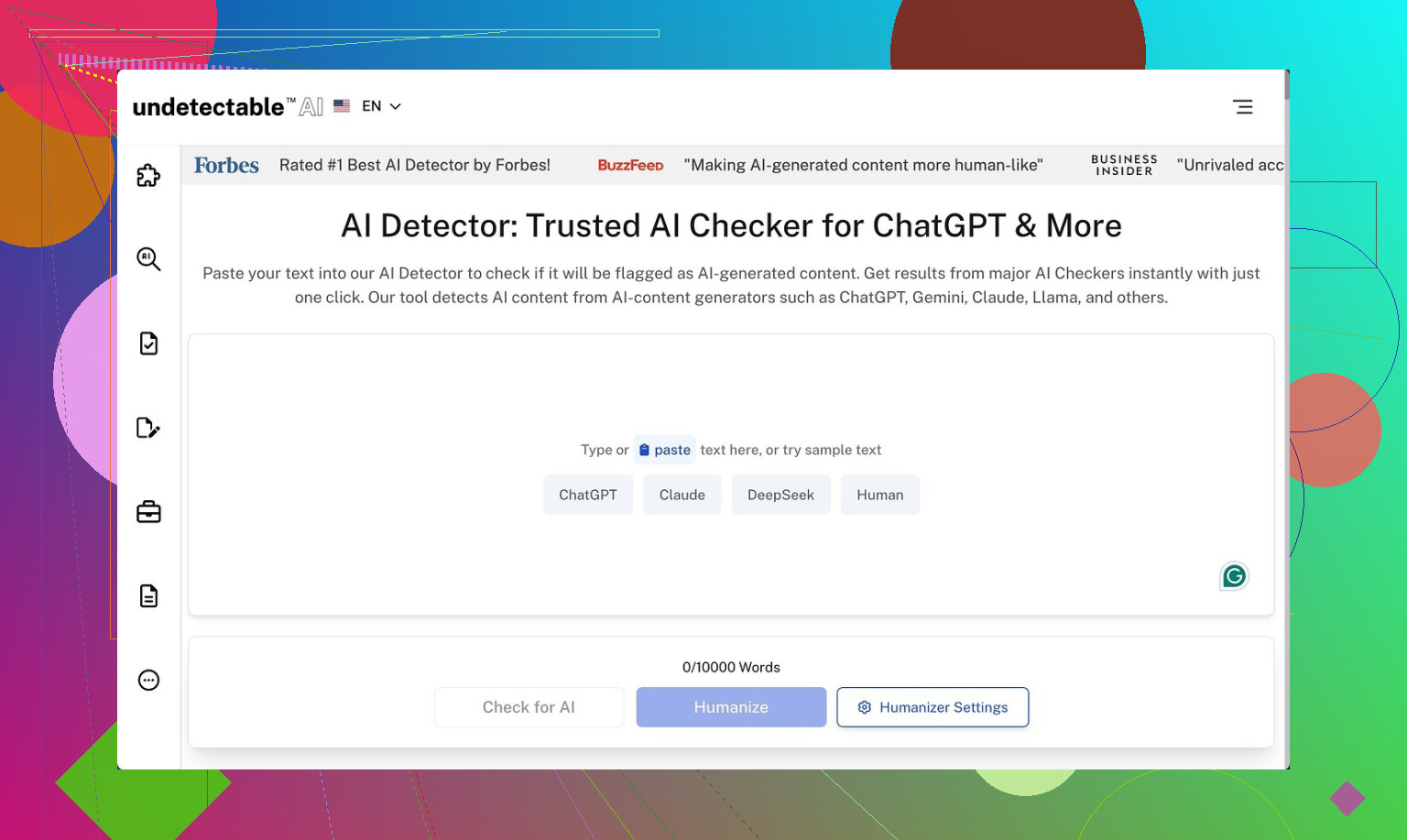
I spent a weekend pushing the free Basic Public model on Undetectable AI to see how far it goes before detection tools flag it.
You only get that one model without paying:
Even so, the detection scores surprised me a bit. Using the “More Human” setting, I kept seeing numbers like:
- ZeroGPT: around 10 percent AI
- GPTZero: around 40 percent AI
Those scores beat a bunch of paid tools I tested earlier in the year. On raw evasion, it holds up.
The paid side
Once you subscribe, they unlock:
- Extra models called Stealth and Undetectable
- Five reading levels
- Nine “purpose” modes
- Intensity controls
I did not test the paid ones deeply, but the feature list hints they are trying to squeeze lower detection scores out of different use cases, like essays vs blog posts.
Where it falls apart
Quality.
The “More Human” mode feels clumsy. If I had to rate it, I would give it maybe 5 out of 10 for writing. A few patterns stood out across multiple runs:
-
Constant first person spam
It keeps forcing phrases like “I think”, “I feel”, “from my perspective”, even when the input is neutral or technical. After a few paragraphs, it reads fake and forced. -
Repeated keywords
Certain nouns and verbs loop. You start seeing the same phrasing every other sentence, like old-school SEO stuffing. -
Odd sentence fragments
It breaks sentences in weird spots. Some outputs looked like rough notes, not finished text.
I tried “More Readable” next. That mode toned down the first person noise a bit. The text flowed a little better, but I still would not paste it straight into anything serious without a full rewrite. For school work or client work, you would need to edit heavily.
Pricing and limits
Entry pricing when I checked:
- About $9.50 per month on an annual plan
- Word limit around 20,000 words per month on that tier
If you write a lot, you burn through that fast. For light use, it might be enough if you are very selective.
Privacy and data
The thing that made me pause was the data collection. Their policy mentions they track fairly specific demographic info, including:
- Income range
- Education level
Most tools stick to email plus usage data. Income and education felt too granular for a text rewriting tool. If you are sensitive about data, read their policy end to end before signing up.
Refund “guarantee”
They advertise a money-back guarantee, but the rules are tight:
- You need to prove your content scored below 75 percent human
- You need to do this within 30 days
- Detection tools differ a lot, so which tools “count” matters
So it is not “did not like it, here is a refund”. You have to gather detection results and argue your case. The guarantee sounds better in the promo line than in the fine print.
Who this fits
If your only goal is to push detection scores down and you do not mind editing, the free model already does decent work on that front. For polished text you can publish without heavy cleanup, it falls short.
Treat it as a rough filter that helps you get under some thresholds, not as a final writing tool. You will still do a lot of manual fixing on tone, repetition, and structure.
2 Likes
I’ve used Undetectable AI on and off for client blogs and some test sites, so here is the blunt version.
Short answer on SEO and long term use
• For money content or long term sites, I would not rely on it as your main workflow.
• For low risk stuff, tier 2 content, or outlines, it is fine if you edit hard.
• If your goal is “never get flagged” you are playing a losing game anyway. Detectors change, logs do not.
Where my experience differs a bit from @mikeappsreviewer
They are right about the “I think / I feel” spam, but I saw that more on general topics. On technical or how to content, the output stayed a bit more neutral. Still chunky though. I would rate quality 6 out of 10, not 5, if you keep prompts short and focused.
What worked ok for me
-
Short chunks
• 150 to 250 words per run.
• Longer inputs started to spiral into repetition.
• I fed it sections, then stitched and edited myself. -
Post editing routine
• Remove all fake first person.
• Swap out repeated verbs and nouns.
• Fix sentence fragments and join short lines.
• Run Grammarly or LanguageTool after. -
SEO angle
• I do not let it touch title tags, H1, or key on page elements.
• I use it only on body text that supports the main point.
• Internal linking, structure, and topical coverage matter more than detector scores in my tests.
On detection tools
My own rough tests across 4 detectors, including ZeroGPT and GPTZero, match what @mikeappsreviewer saw. Low to medium AI scores on “More Human” mode. I do not trust those tools fully though. They throw false positives on human text and false negatives on some AI text. Google has said they target spammy patterns and low quality, not “AI or human” as a binary.
Real SEO risk
The risk is not “this was run through Undetectable AI”. The risk is:
• Generic content with no expertise.
• Same structure across many articles.
• Overuse of certain phrases that signal template style output.
• No experience, examples, or data from you.
If you keep feeding it long form then publishing with minimal edits, expect problems later. Maybe not a penalty, but weak rankings and poor user signals.
Privacy and data
The income and education tracking in their policy is a red flag for some people. I agree with @mikeappsreviewer on that. If you work with clients in sensitive niches, think about that before uploading drafts.
Refund guarantee
I would ignore the guarantee in your decision. Tying refunds to specific detector scores is messy. Detection tools change, thresholds differ. Treat that as marketing.
What I would do in your position
-
Decide your risk level
• Client SEO sites or real brand: use it only as a helper, not a full rewrite engine.
• Test sites, churn and burn: use it more aggressively, but expect churn. -
Use AI humanizers as part of a stack
Flow that worked best for me:
• Write outline and key talking points yourself.
• Use a main LLM for a first draft.
• Use a humanizer to rough up phrasing if you are worried about detectors.
• Edit heavily, add your own examples, stories, screenshots, and stats. -
Look at an alternative focused on control
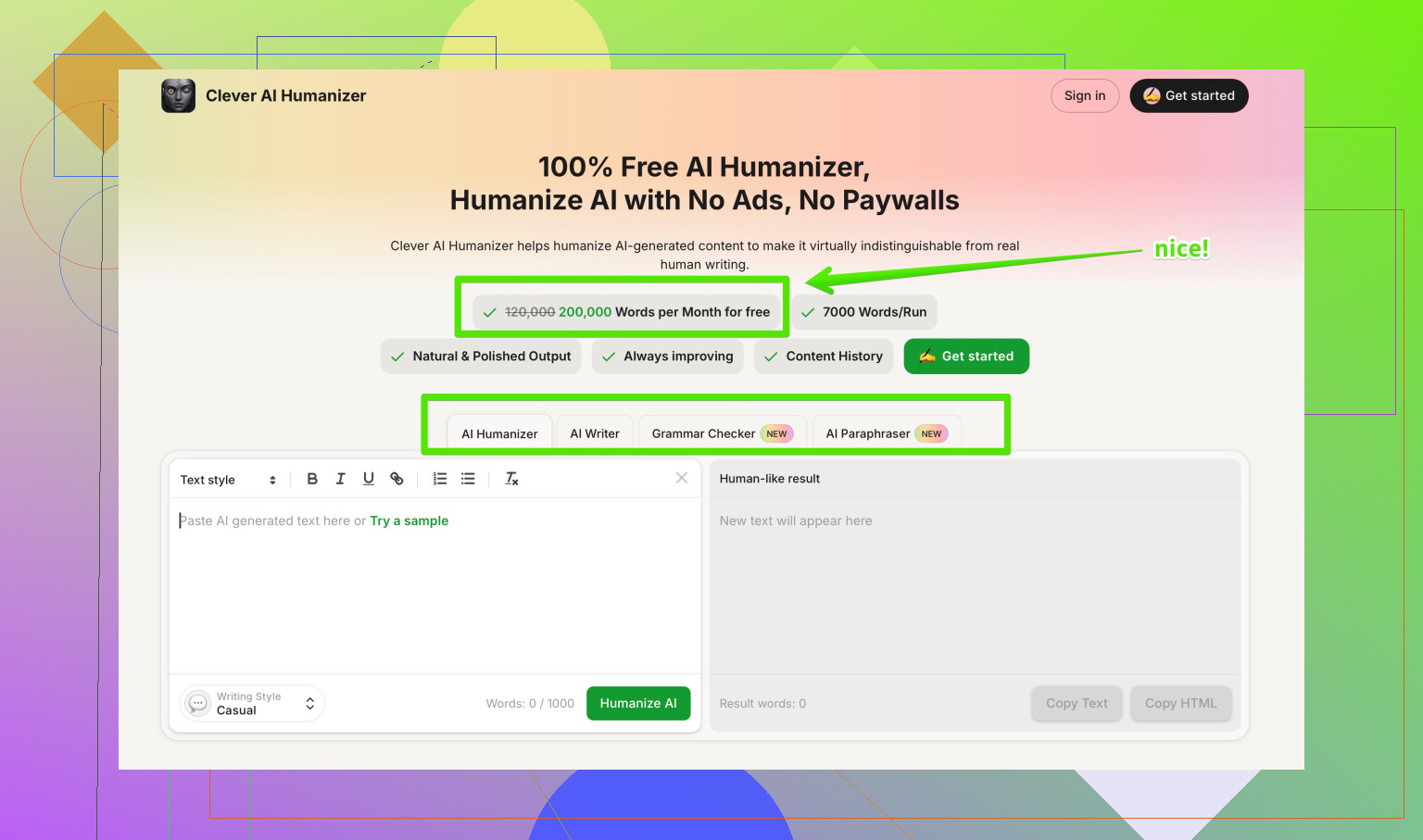
If you want more control and less “I think / I feel” noise, try something like Clever AI Humanizer. It focuses on natural language, detection evasion, and preserving your tone. The interface is simpler than Undetectable AI and it targets bloggers, students, and SEO writers who want readable output without obvious AI fingerprints. You can check it here:
make your AI text sound more human and SEO friendly
That type of tool combined with strong editing and your own insights feels safer for long term SEO than pushing everything through Undetectable AI on auto pilot.
Bottom line
• Use Undetectable AI as a rough filter, not a publish button.
• Do not chase 0 percent AI scores at the cost of quality and info.
• Put more effort into originality, structure, and on page SEO than detector paranoia.
Used it quite a bit across a couple affiliate sites and one “real” brand site, so here’s the unvarnished take, trying not to repeat what @mikeappsreviewer and @espritlibre already covered.
1. Reliability for “passing detectors”
It does drop scores on ZeroGPT / GPTZero in my experience, similar to what they reported. But:
- Detection results are all over the place between tools
- Scores change if you re-run the same text a few days later
- Some of my “95% human” stuff still got flagged elsewhere as mostly AI
So if your main KPI is “detector score under X,” you’re building on sand. I wouldn’t base any long term SEO strategy on that.
2. Long term SEO & “safety”
Where I slightly disagree with the other two: I think the main SEO risk is homogenization, not just low quality.
Patterns I kept seeing when I used Undetectable AI at scale:
- Same rhythm and sentence length across articles
- Transitional phrases repeating (“on the other hand,” “it’s important to note,” etc.)
- Very neutral, middle-of-the-road claims, almost no strong stance
That combo screams “template-ish content.” Even if Google is not running literal AI detectors, it absolutely can pick up on:
- Repetitive discourse patterns
- Thin insight compared to top ranking competitors
- Lack of real-world examples, numbers, or opinions
On one site where I leaned hard on Undetectable + light edits, new posts indexed fine but plateaued at page 2–3. When I started replacing sections with my own takes, case examples, screenshots, and data, rankings moved more than any “humanization” tweak ever did.
3. Workflow risk almost no one talks about
If you keep:
- Generating with a main LLM
- Piping into Undetectable AI
- Doing minimal edits
You end up:
- Doubling your AI fingerprints
- Introducing extra artifacts (their “I think / I feel” thing, weird fragments, etc.)
- Spending time you could use to just rewrite a paragraph in your own voice
At some point it’s just workflow bloat. For me, Undetectable only made sense when I heavily customized the outputs afterward, which kinda kills the “time saver” angle.
4. Privacy / data angle
I agree with both of them on the demographic tracking being weird, but I’ll push it a step further:
If you run client material, NDAs, or anything sensitive through any third-party “humanizer,” you should assume:
- Text can be logged
- User-level data can be profiled more than you think
- Future model training could, in theory, touch your content
For me, that pushed Undetectable AI into “only for my own low-risk stuff” territory.
5. Alternative approach instead of chasing 0% AI
I’d flip the strategy around:
- Don’t optimize for “human score”
- Optimize for: uniqueness, depth, and voice
Tools like Clever AI Humanizer are a better fit for that mindset. It focuses a bit more on natural language flow and keeping things readable and SEO friendly rather than just bulldozing detectors. When I swapped some Undetectable outputs with Clever AI Humanizer on a tech blog, I got:
- Fewer awkward first-person tics
- More consistent tone with my original draft
- Less post-editing to sound like an actual human
Still needed manual editing, but at least it didn’t feel like I was fighting the tool.
6. Practical answer to your question
If you:
- Run a long term brand or serious money site → use Undetectable AI sparingly, only on body text, and rewrite aggressively with your own insight.
- Run churn sites / tier 2 content / PBNs → it’s “good enough” as a noise layer, but accept that some pages will flop or get quietly devalued.
Trying to guarantee “AI undetectable forever” is just not a realistic or stable SEO play.
Side note, if you’re comparing tools and poking around Reddit, check discussions like
finding the most reliable AI humanizers recommended by real users.
The crowd wisdom there plus testing something like Clever AI Humanizer side by side with Undetectable on your niche will tell you more than any detector screenshot.
On the “is this safe for long‑term SEO” question, I think you are looking at the wrong variable if you focus on Undetectable AI itself. The real dials that matter:
1. How much of the article is actually you
If 70–80% of a page is essentially regenerated boilerplate (whether from a normal LLM or a humanizer), you are competing in the commodity bucket. Google is increasingly rewarding:
- Specific stories, examples, screenshots, numbers
- Local or niche context
- Opinions that could be right or wrong, not Wikipedia‑neutral fluff
Undetectable AI, in my tests, tends to smooth everything toward safe middle ground. That is okay for filler, not okay for pages that must rank and convert.
2. Pattern footprint across the whole site
Where I differ a bit from @espritlibre and @shizuka: I worry less about “I think / I feel” quirks and more about global footprints:
- Same intro pattern on 30 posts
- Identical transition phrases
- Paragraph length and cadence repeating across a cluster
You can get this even if detector scores look fine. At scale that is what makes a site feel AI‑heavily produced.
3. Practical split that has worked better for me
Instead of “humanize everything,” I split content like this:
-
Critical money pages & main hubs
- Write or heavily rewrite yourself.
- Use AI only to brainstorm angles, FAQs, comparisons.
- Do not run these through Undetectable AI at all. It is not worth the risk or the loss of voice.
-
Support posts / FAQ clusters / low‑stakes pieces
- Generate with your main LLM.
- Optionally run the dull sections through a humanizer to vary phrasing.
- Edit to inject at least 2 or 3 real insights or examples.
On those second‑tier pieces, I have had better luck recently with Clever AI Humanizer than with Undetectable AI, especially when I care about readability:
Clever AI Humanizer – pros
- Keeps tone closer to the original draft than Undetectable AI in my tests.
- Less obsessive about fake first‑person filler.
- Easy to use for quick passes on sections that feel too “LLM‑flat.”
- Output often needs light instead of heavy surgery, which matters if you are doing this at volume.
Clever AI Humanizer – cons
- Still not “paste & publish.” If you expect finished copy, you will be disappointed.
- Can slightly over‑simplify technical explanations if you are not careful with settings.
- Like any humanizer, it is still layered AI, so you must watch for subtle factual drift.
- Using it as a crutch across an entire site can still produce that homogenized feel, even if it reads nicer.
4. Where Undetectable AI actually fits
Given what @mikeappsreviewer already showed with detection numbers, I would use Undetectable AI in only two scenarios:
- You have legacy AI content that already exists and you want to “rough it up” before manually editing.
- You are doing experimental, disposable, or short‑lived projects where long‑term footprint barely matters.
For a brand or client property with real goals, it should be a surgical tool, not the core writing engine.
5. How to test it for yourself without guessing
Instead of obsessing over detector screenshots:
- Pick 3 posts in the same niche.
- Version A: your normal LLM draft + your own edit, no humanizer.
- Version B: LLM draft + Undetectable AI + your edit.
- Version C: LLM draft + Clever AI Humanizer + your edit.
- Track:
- Time spent per article
- How “samey” each feels when you read them back to back
- Early user behavior signals (CTR, time on page, scroll depth)
- Ranking movement over 4–8 weeks
Most people skip this simple experiment and then argue about detectors instead of results.
Bottom line
- Undetectable AI is not inherently “unsafe,” it is just easy to overuse and flatten your content.
- Clever AI Humanizer is a viable alternative for making AI text more human and SEO friendly, but it still needs your voice on top.
- Long‑term SEO safety comes from originality, depth and consistent author identity, not from hitting 0% AI on some third‑party tool.