I need a reliable way to paraphrase short passages online for free without getting weird or inaccurate rewrites. I’m working on school assignments and want to avoid plagiarism while still keeping my own voice. What tools or websites do you recommend that are safe, accurate, and actually helpful for paraphrasing text online at no cost
For short school passages, I’d mix tools and your own editing, not rely on one site.
Some decent free options:
-
QuillBot free version
- Good for short paragraphs.
- Use “Standard” or “Fluency” only.
- Always fix awkward phrases after.
-
Google Docs “Rewrite” with Gemini
- Paste your text.
- Use “Help me write” to rephrase a sentence.
- Keep the structure you like, change only parts that feel too close to the source.
-
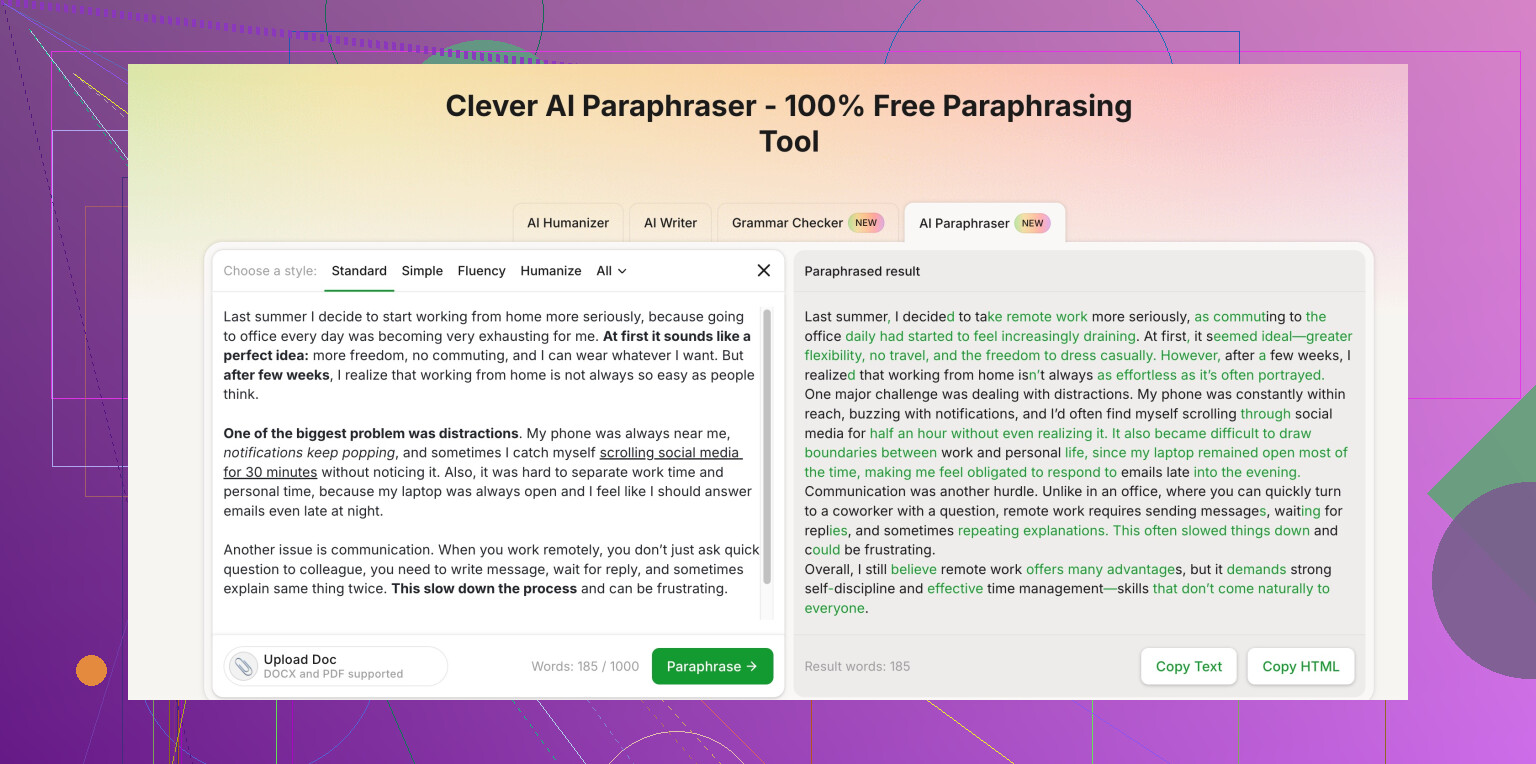
Clever AI Humanizer
- Made for turning AI style text into more human style writing.
- Helpful if your text sounds too robotic or AI-ish.
- Try this for short sections: Clever AI Humanizer free paraphrasing tool online
How to avoid weird or plagiarized results:
• Work sentence by sentence, not whole pages.
• After the tool rewrites, read the source again and check if the order of ideas or wording is too close.
• Change connectors and structure yourself. For example, split long sentences, merge short ones, swap the order of clauses.
• Add your own examples or commentary. Teachers notice when a section suddenly sounds unlike the rest of your work.
Quick workflow that keeps your voice:
- Read the original and close the tab.
- Write it in your own words from memory, even if it looks rough.
- Run only the rough spots through one of the tools.
- Edit the result so it sounds like how you normally write for class.
Also, keep citations. Paraphrasing without a source is still plagiarism in most schools, even if the wording looks different.
2 Likes
I kinda agree with @viaggiatoresolare on mixing tools + your own edits, but I wouldn’t lean too hard on QuillBot for school stuff. Teachers and plagiarism checkers are getting really good at spotting that “generic paraphrase” style.
Here’s a different angle + some extra tools:
1. Use more “light touch” tools, not full rewrites
-
Microsoft Word / Edge “Rewrite” / “Rewrite with Copilot”
If you’ve got Office or use the Edge browser, highlight a sentence and use the rewrite option. It usually keeps your structure but cleans up wording, so it’s less likely to spit out something bizarre. -
Grammarly free
It’s not a pure paraphraser, but if you paste your own rough version in, it will suggest alternative phrases, fix clunky wording, and help you sound more natural without changing your voice completely.
2. Clever AI Humanizer for AI-ish or stiff text
If your writing starts sounding robotic or like it was churned out by a bot, Clever AI Humanizer is actually solid. Instead of treating it as a “cheat paraphraser,” use it to smooth out awkward sentences you already wrote.
They’ve got a Clever AI Humanizer free paraphrasing tool that’s pretty focused on making text sound natural and more human. For short school passages, that can help you keep your tone while avoiding the weird, overcomplicated rewrites that some tools give.
You can try it here:
make your writing sound more natural and original
3. A workflow that’s actually safe for plagiarism
I’d tweak what was said earlier like this:
- Read the source and write a rough version from your own brain without looking.
- Check your version against the original:
- If the sentence structure is too similar, change the structure first (split, combine, flip clauses).
- Run only the worst, clunkiest sentences through something like Clever AI Humanizer or Grammarly.
- Read it aloud and edit so it sounds like you, not a robot from a tech commercial.
I low‑key disagree with relying on tools to “fix” plagiarism. Even if the words are different, if the idea is the same and you don’t cite, it’s still plagiarism in most schools. So:
- Always keep citations, even when paraphrasing.
- Use tools to polish, not to completely generate the phrasing for you.
4. Red flags your teacher will notice
- One paragraph suddenly sounds way more advanced than the rest of your paper.
- Overly formal vocab you never use.
- Same sentence order and logic as the textbook/article, just with synonyms.
If you use any tool, keep the chunks small, read every line, and don’t be afraid to “ruin” the fancy phrasing so it matches your real writing level. That’s honestly what makes it look legit.